
There's a specific kind of frustration that comes with sitting on the water at the launch ramp, key in the lanyard clip, thumb on the start button, and nothing happens. If your jet ski won't start, you're not alone, and the good news is that the cause is usually something simple. Most no-start situations trace back to a handful of predictable culprits: a battery that's given up, fuel that's gone stale over winter, a safety lanyard that isn't seated right, or a spark plug that's fouled out.
The trick is knowing how to narrow it down instead of guessing. Below, we'll walk through the diagnostic path a technician actually follows, in the order that makes sense, so you can figure out what's wrong without throwing parts at the problem.
Start Here: What Happens When Your Jet Ski Won't Start?
Before you touch anything, pay attention to what your ski does when you press start. This single observation eliminates half the possibilities.
Nothing at all — no click, no lights, no beep. You're looking at an electrical supply problem. Dead battery, corroded terminal, blown main fuse, or a lanyard that isn't making contact.
A rapid clicking sound. The starter solenoid is trying to engage but there isn't enough current behind it. Almost always a weak battery or a bad connection at the terminals.
The engine cranks but never fires. Power is fine. Now you're chasing fuel, spark, or compression.
One slow, labored crank, then nothing. Could be a marginal battery, or the engine could be hydrolocked — water where it shouldn't be. Stop and read the hydrolock section before you try again.
Everything sounds normal, engine turns over, still no start. Fuel delivery or ignition. Usually fuel.
That's your fork in the road. Take note of which one you're dealing with and follow the relevant section below.
Cause #1: A Dead Jet Ski Battery (The Usual Suspect)
If we had to bet on one cause sight unseen, it would be this. A dead jet ski battery is behind more no-start calls than everything else combined, and it makes sense when you think about how these machines live. A jet ski might sit for six months over winter, then sit again between weekend rides. Batteries hate that.
Personal watercraft batteries are small — they don't have the reserve capacity of a car battery, so they drop off a cliff much faster. A three-year-old PWC battery that sat all winter without a tender is frequently done, even if it reads 12 volts on a multimeter.
How to confirm it:
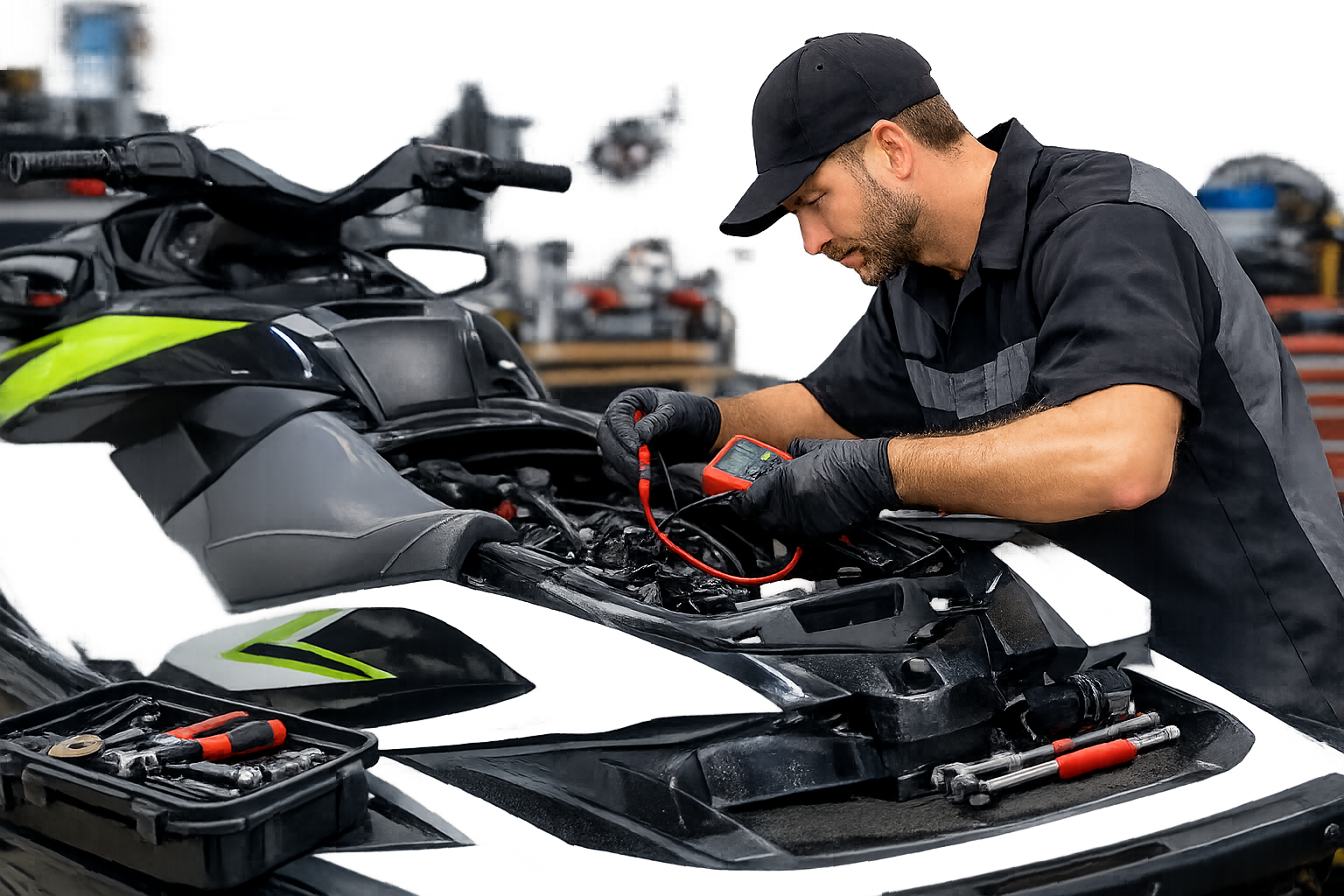
1. Check voltage at rest with a multimeter. A healthy battery reads 12.6–12.8V. Below 12.4V is undercharged. Below 12.0V and it's likely sulfated and won't recover.
2. Watch your gauges when you press start. If the display dims dramatically or blanks out, that's a battery under load failing to hold voltage.
3. Look at the terminals. White or green crust means resistance, and resistance means the starter isn't getting the amperage it needs.
What to do:
Clean the terminals with a wire brush and a baking soda solution, then reconnect them snugly — not gorilla-tight, since the lead posts strip easily. Charge the battery with a proper marine or AGM-compatible smart charger. Automotive chargers can push too much current for a small PWC battery.
If the battery charges up and then dies again after a ride or two, either the battery won't hold a charge anymore or something is draining it. A parasitic draw from an aftermarket stereo, a stuck bilge pump, or a failing stator all show up this way.
One thing worth knowing: jump-starting a jet ski from a car is risky. A running car's charging system can push current the PWC's electronics were never designed to handle, and blown ECUs from improvised jumps are a real and expensive thing. If you jump it, jump from another battery only, engine off.
Cause #2: The Lanyard, Kill Switch, and Start/Stop Circuit
This one embarrasses experienced riders regularly. The safety lanyard has to be seated correctly for the ignition circuit to close. If it's slightly off, worn, or if the post is corroded, you get absolutely nothing when you hit start.
Pull the lanyard off completely, wipe both the clip and the post, and reseat it firmly. On some models you'll hear a beep confirming it registered. If you have a spare lanyard, swap it in — the magnets and contacts inside wear out.
While you're there, check that the ski isn't in a security or learning key mode. Sea-Doo's DESS system, for instance, will refuse to start with an unprogrammed key, and it isn't always obvious that's what's happening.
Cause #3: Jet Ski No Spark Conditions
If the engine turns over healthily but never catches, ignition is one of your two prime suspects. A jet ski no spark problem can come from several places.
Fouled or worn spark plugs. By far the most common. Plugs foul from rich running, oil contamination in two-strokes, or extended idling. Pull them and look: black and sooty means rich or fouled, wet with fuel means it's flooded, oily means something more serious upstream. A tan or light gray plug is a healthy plug.
Water intrusion. Water in the plug wells or connectors kills spark instantly. It's more common than people expect, especially after a ski has been swamped, rolled, or stored uncovered.
Failed ignition coil or CDI unit. These fail intermittently before they fail permanently, which is why a ski might start fine cold and refuse to start once it's warm.
Testing it: Remove a plug, reconnect the plug boot, ground the plug body against the engine, and crank while watching for a blue spark across the gap. Weak orange spark or no spark tells you where to look next. Be careful — do this away from fuel vapor, and keep your hands off the metal.
If your plugs look fine and you still have no spark, you're into electrical diagnostics that benefit from a shop with the right test equipment.
Cause #4: Fuel Problems and Stale Gas
Modern ethanol-blended fuel goes bad faster than most people expect. Two to three months in a vented tank and it starts absorbing water and separating. By spring, gas from last summer isn't really gas anymore.
Symptoms of a fuel problem look like: the engine cranks strong, maybe coughs or sputters, might start and immediately die, or runs rough at idle and won't hold.
Things to check:
1. Is there actually fuel in the tank? Gauges fail, and it's a quick check.
2. Smell the fuel. Stale gas has a distinct sour, varnish-like odor.
3. Listen for the fuel pump priming for a second or two when you turn the key on. Silence points to the pump, its relay, or its fuse.
4. Check the fuel filter and water separator if your model has one.
If you're confident the fuel is old, the fix is draining the tank and refilling with fresh gas, ideally with a stabilizer. If the ski sat with bad fuel for a long time, the injectors or carburetor may be gummed up and need a proper cleaning.
Cause #5: Jet Ski Won't Turn Over — Mechanical Causes
When your jet ski won't turn over and the battery has been ruled out, you're dealing with something mechanical or with the starter circuit.
Hydrolock. Water in the cylinders means the engine physically cannot compress. Trying repeatedly can bend a connecting rod, which turns an afternoon problem into a rebuild. If the engine feels like it hits a wall and stops, stop cranking. This often follows a rollover, a swamping, or a bad exhaust setup letting water backflow.
Starter motor or solenoid failure. A solenoid that clicks once and does nothing else, or a starter that spins without engaging, points here.
Seized engine. Rare, but it happens after long storage with water in the cylinders, or after a ski was run without proper lubrication.
Hydrolock and seizure are both situations where doing nothing is smarter than doing something. If you suspect either, get it to someone who handles Jet Ski & Personal Watercraft Repair before you make it worse.
Cause #6: Flooding
If you cranked it a dozen times hoping for a different outcome, you may have flooded it. Wet, fuel-soaked plugs confirm it.
The fix on most models: remove the plugs, crank the engine briefly to clear fuel from the cylinders, let it air out, dry or replace the plugs, and reinstall. Then start it without touching the throttle. Many skis also have a clear-flood mode — check your manual, since the procedure differs by manufacturer.
Water Damage: The Cause People Miss
A ski that was submerged, rolled, or took on water through the exhaust doesn't always fail immediately. Sometimes it starts fine that day and refuses to start two weeks later, once corrosion has worked into connectors and the engine internals have had time to rust.
If your ski has been swamped and now won't start, don't keep cranking. Water in the cylinders or oil is an urgent situation, not a wait-and-see one. Insurance & Water Damage Repair is a legitimate path here, and documenting the incident early matters if you plan to file a claim.
When It's Time to Call a Professional
You can reasonably handle: battery testing and replacement, terminal cleaning, plug inspection and replacement, lanyard troubleshooting, fresh fuel, and clearing a flood.
It's worth handing off when: you have confirmed no spark after basic checks, you suspect hydrolock or water in the engine, there's an intermittent electrical fault, the battery keeps draining, or the ski cranks but has no compression.
Diagnostic tools matter here. Manufacturer software reads fault codes from the ECU that tell you in thirty seconds what could take a weekend to guess at. Shops like Precision Powersports Service that specialize in Personal Watercraft Repair have that equipment and the pattern recognition that comes from seeing the same failures across hundreds of machines.
How to Avoid This Next Season
1. Keep the battery on a maintainer during storage. This one habit prevents the majority of spring no-start calls.
2. Use fuel stabilizer and store with a nearly full tank to limit condensation.
3. Rinse and flush after every saltwater ride.
4. Replace plugs on schedule rather than waiting for a failure.
5. Winterize properly, including fogging the engine and draining water.
6. Run it briefly a few times over the off-season if you can.
Key Takeaways
1. A dead jet ski battery is the single most common reason a jet ski won't start — check it first, always.
2. What the ski does when you press start (silence, clicking, cranking) narrows the diagnosis immediately.
3. Cranking but not firing means fuel or spark; silence means power or the lanyard circuit.
4. A jet ski no spark condition usually traces to fouled plugs, water intrusion, or a failing coil.
5. Stale ethanol fuel after storage causes a huge share of spring no-starts.
If the jet ski won't turn over at all, stop cranking — hydrolock can destroy an engine in seconds.
6. Battery maintainers and fuel stabilizer prevent most of these problems entirely.
Conclusion
When your jet ski won't start, resist the urge to start swapping parts. Listen to what the machine is telling you, work through the causes in order — battery, lanyard, spark, fuel, then mechanical — and you'll usually find the answer within twenty minutes. Most no-start problems are cheap and simple. The expensive ones are almost always the result of forcing a ski that was trying to tell you to stop.
If you've worked through the basics and it still won't fire, or if you're seeing signs of water intrusion or hydrolock, that's your cue to get a professional set of eyes on it before a small problem becomes a rebuild.
FAQs
If the battery is healthy and your jet ski won't start, check the safety lanyard is seated properly, then look at spark plugs and fuel. Stale fuel and fouled plugs are the most common causes when power isn't the issue. A ski that cranks but doesn't fire almost always has a fuel or ignition problem.
Test resting voltage with a multimeter. A healthy PWC battery reads 12.6–12.8 volts. Below 12.0 volts indicates a dead jet ski battery that likely won't recover. Rapid clicking when you press start, or gauges dimming, are also reliable signs.
A jet ski no spark condition is usually caused by fouled or worn spark plugs, water in the plug wells or connectors, a failed ignition coil, or a faulty CDI unit. Start by pulling the plugs and inspecting them — black, oily, or wet plugs point to the answer.
It's not recommended. A running car's charging system can send more current than a jet ski's electronics can handle, potentially damaging the ECU. If you must jump it, use another battery with the vehicle's engine off, or better, charge the PWC battery properly.
Clicking without cranking means the starter solenoid is engaging but there isn't enough current to spin the starter. This is nearly always a weak battery or corroded connections. If the battery tests good and it still clicks, suspect the solenoid or starter motor.
Contact Precision Powersports Service
If your bike is overheating, losing coolant, running hotter than usual, or due for cooling system maintenance, don’t wait—cooling issues only get worse with time.